
Rethinking Normal: How Automation Adds Safety to Pathology Result Review
Not every result within range is clinically safe in isolation. Here’s how intelligent automation is changing the way practices manage pathology – without sacrificing safety.
In general practice, time is one of the most limited and valuable resources. Yet a significant portion of the day is spent reviewing pathology results,most of which are normal. However, not all “normal” results are clinically safe in isolation. A result may fall within range but still require review when considered alongside the patient’s medical history, medications, or existing conditions.
This means every result must be interpreted in the context of the individual patient, adding complexity, time, and risk to an already high-volume process.
In general practice, time is one of the most limited and valuable resources. Yet a significant portion of the day is spent reviewing pathology results — most of which are normal. However, not all “normal” results are clinically safe in isolation. A result may fall within range but still require review when considered alongside the patient’s medical history, medications, or existing conditions.
This means every result must be interpreted in the context of the individual patient — adding complexity, time, and risk to an already high-volume process.
The Scale of the Problem
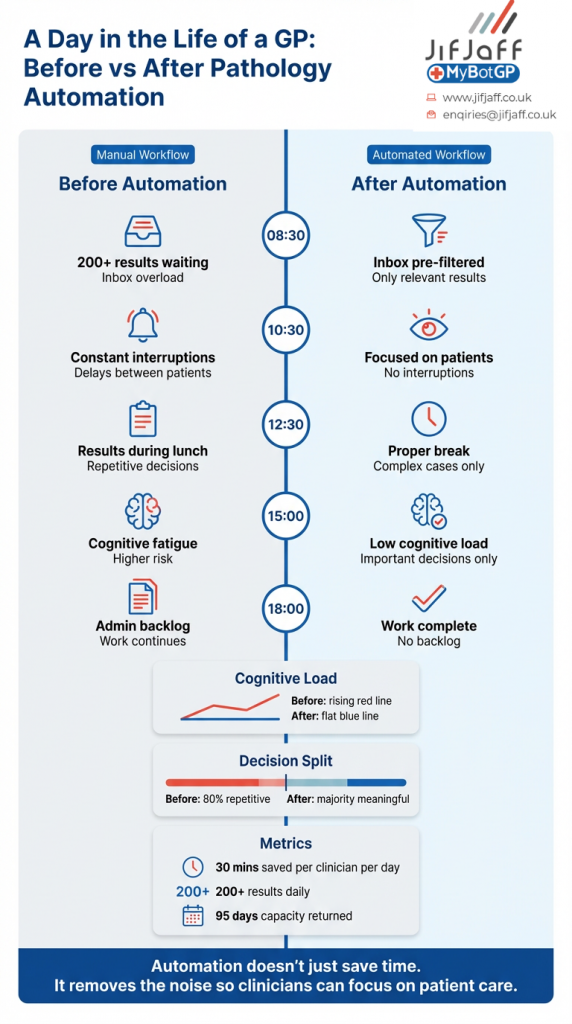
In a typical GP practice, the volume of pathology results is significant — and the burden on clinicians to review each one carefully is real.
-
➢ 62,000+ pathology results processed per year in a typical GP practice
-
➢ ~80% are normal, but still require review against patient context
-
➢ 30 min spent per day by clinicians checking and processing results
Each result must be checked not just for its value, but for what it means for that specific patient. That’s the critical distinction — and the source of the challenge.
“Normal” does not always mean safe. A result within range can still carry risk when viewed in the context of that patient’s conditions, medications, and clinical history.
How Automation Adds Safety Not Just Speed
Automation is not simply about filing results faster. It introduces a consistent safety layer by applying structured patient contextual checks to every result — something that is difficult to sustain manually at scale.
1. Result Received
A pathology result arrives in the practice system.
2. Context Check
Automated checks validate the result against the patient’s conditions, medications, and clinical history.
3. Safety Assessment
Additional logic ensures the result is clinically safe for that specific patient — not just within range.
4. File or Flag
Results that pass are automatically filed. Anything requiring attention is flagged for clinical review.
This means automation doesn’t remove clinical oversight — it strengthens it. Clinicians are freed from repetitive validation and directed only to cases that genuinely need their attention.
The Real Impact on Practice
By combining efficiency with safety, practices using intelligent automation are seeing tangible benefits:
-
➢ Free up valuable clinical capacity previously consumed by routine result review
-
➢ Reduce backlog and processing delays across the practice
-
➢ Apply patient context consistently across all results — every time, without variation
-
➢ Lower cognitive load on clinicians while improving overall decision quality
-
➢ Enable clinicians to focus on complex, high-value cases
Most importantly, clinicians can focus on complex cases with confidence — knowing routine results have been safely managed by a consistent, structured process.
Why This Matters Now
Demand in primary care continues to grow, while available clinical capacity remains under pressure. The expectation for safety and thoroughness has never been higher yet the time available to deliver it has never felt more constrained.
Automation bridges this gap not by replacing clinical judgement, but by handling the structured, repeatable aspects of result review that don’t require it. By reducing workload, standardising patient contextual checks, and supporting more consistent decision-making, automation gives practices a way to do more safely.
Automation doesn’t just save time. It adds a layer of safety — ensuring results are interpreted in the right patient context, every time.
See It in Action
Want to see how automation safely applies patient context and frees up clinical capacity in a real GP practice?
LIVE WEBINAR | FREE TO ATTEND
MyBotGP – Normal Pathology Filing
-
➢ How practices are reducing manual workload with intelligent automation
-
➢ How safety is added through structured patient contextual checks
-
➢ How to reclaim clinical capacity immediately